
Articulated dog STL files have become one of the most popular categories in 3D printing. Their flexible joints, adorable designs, and print-in-place functionality make them a favorite among hobbyists, makers, and small businesses. Whether you’re printing for fun, creating gifts, or selling physical prints, understanding how to print articulated dog models correctly can save time, reduce failed prints, and produce smoother, stronger results.
In this guide, you’ll learn everything you need to know about Articulated Dog STL Bundle Guide, including recommended slicer settings, filament choices, common printing mistakes, troubleshooting tips, and how to choose high-quality models.
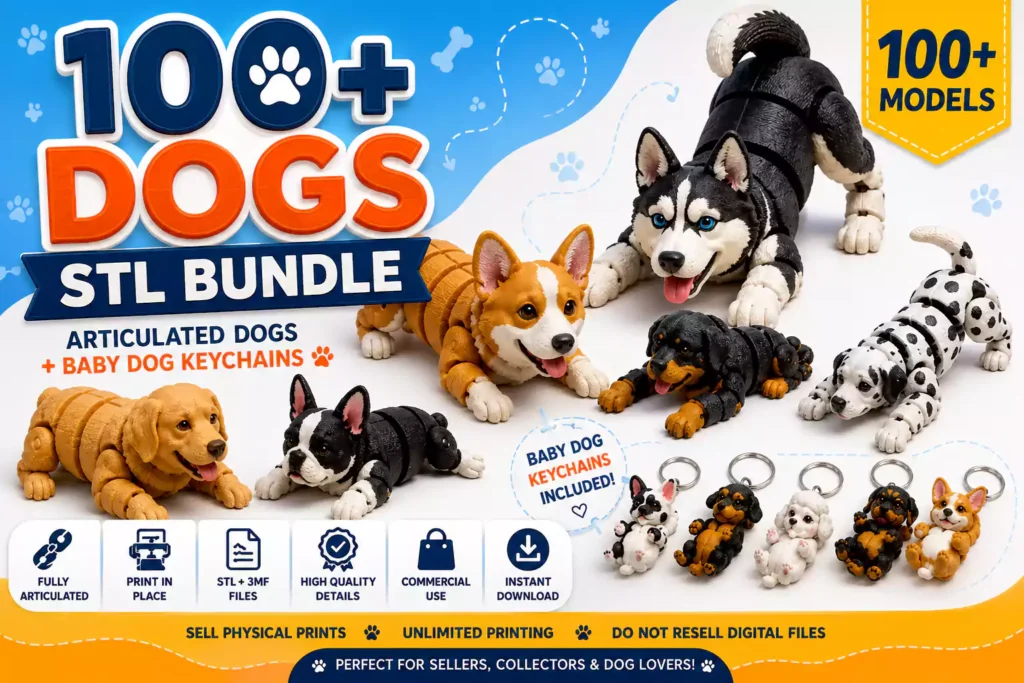
Table of Contents
Articulated Dog STL Bundle Guide: What Is Included?
An articulated dog STL is a 3D printable model with built-in moving joints. Instead of printing separate parts and assembling them later, these models are designed to print in one piece. Once removed from the build plate, the joints move freely, creating a flexible toy or display model.
Most articulated dog models use carefully designed joint clearances that allow movement immediately after printing while maintaining strength and durability.
These files are commonly used for:
- Desk toys
- Fidget toys
- Gifts for dog lovers
- Home decoration
- Craft fairs
- Etsy shops
- Small business products
- Educational demonstrations
Why Print-in-Place Models Are So Popular
Print-in-place technology has changed desktop 3D printing by eliminating assembly for many designs.
Benefits include:
- No glue required
- No screws or hardware
- Faster production
- Beginner-friendly printing
- Reduced post-processing
- Consistent results
- Great for batch printing
For businesses selling physical prints, this means faster production and lower labor costs.
Choosing High-Quality Articulated Dog STL Files
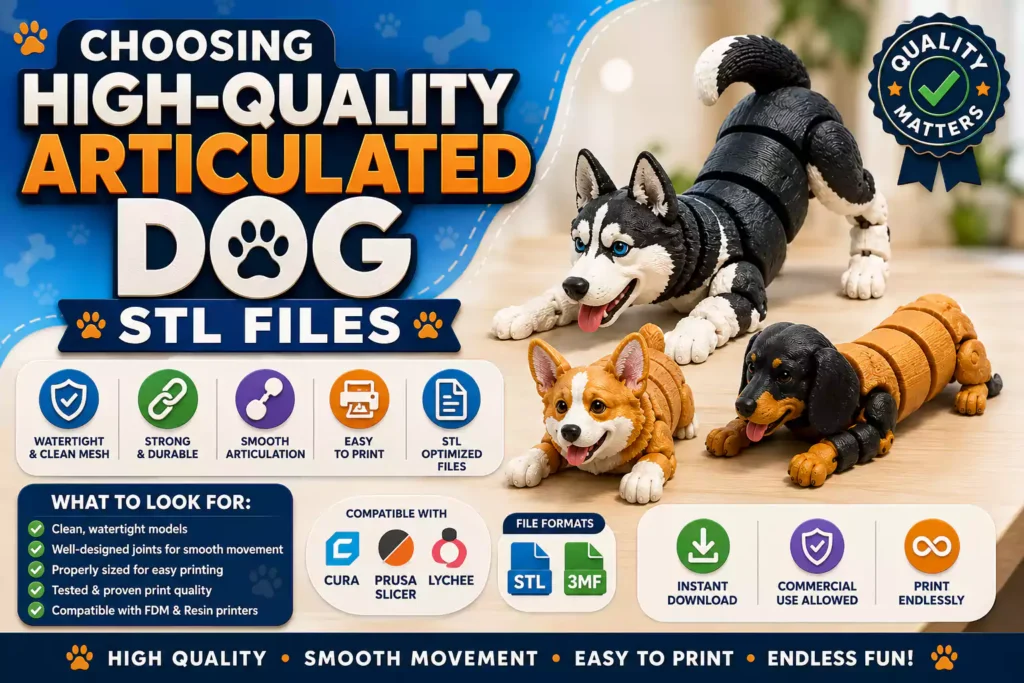
Not every STL file is designed the same way. High-quality articulated models usually include:
- Proper joint tolerances
- Smooth articulation
- Clean mesh geometry
- Optimized wall thickness
- Reliable print orientation
- Support-free printing whenever possible
Poorly designed models often have joints that fuse together or break during the first movement.
Best Filament for Articulated Dog Models
PLA
PLA is the most popular option.
Advantages:
- Easy to print
- Excellent detail
- Minimal warping
- Affordable
- Perfect for beginners
PLA+
PLA+ provides:
- Better durability
- Slight flexibility
- Stronger joints
- Improved impact resistance
PETG
PETG is suitable if extra strength is needed but requires more tuning to avoid stringing.
For most articulated dog models, standard PLA or PLA+ provides the best balance between print quality and ease of use.
Recommended Slicer Settings
While every printer is different, these settings work well for most articulated dog STL files.
| Setting | Recommended Value |
|---|---|
| Layer Height | 0.20 mm |
| First Layer | 0.24 mm |
| Nozzle | 0.4 mm |
| Wall Count | 2–3 |
| Infill | 10–15% |
| Supports | Usually Not Required |
| Build Plate Adhesion | Skirt |
| Print Speed | 45–60 mm/s |
| Travel Speed | 150–200 mm/s |
| Cooling | 100% after first layers |
Always preview your sliced file before printing to verify that joints remain separate.
Best Printers for Articulated STL Files
Most modern FDM printers can print articulated dogs successfully.
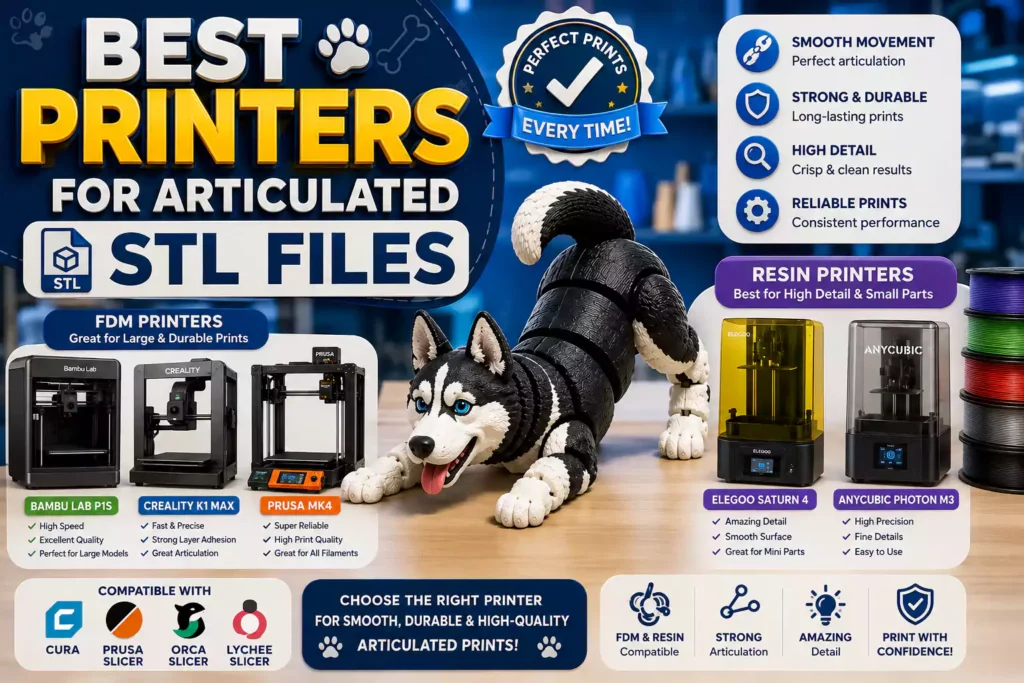
Popular choices include:
- Bambu Lab A1
- Bambu Lab P1P
- Bambu Lab P1S
- Bambu Lab X1 Carbon
- Creality Ender 3 V3 SE
- Creality K1
- Anycubic Kobra Series
- Elegoo Neptune Series
- Prusa MK4
A properly calibrated printer is often more important than the printer model itself.
Common Printing Problems
Joints Are Stuck
Possible causes:
- Over-extrusion
- Incorrect flow rate
- Elephant’s foot
- Incorrect first layer
Solutions:
- Calibrate flow
- Reduce first-layer squish
- Enable elephant foot compensation
- Verify nozzle temperature
Parts Break Easily
Possible causes:
- Low wall count
- Poor layer adhesion
- Wet filament
Solutions:
- Increase wall count
- Dry filament
- Raise nozzle temperature slightly
Stringing Between Joints
Solutions:
- Reduce nozzle temperature
- Increase retraction
- Dry filament
- Tune travel settings
Tips for Better Results
For consistently successful prints:
- Keep filament dry.
- Clean the build plate regularly.
- Level your printer correctly.
- Use quality filament.
- Avoid excessive print speeds.
- Allow the print to cool before removing it.
- Flex joints gently the first time.
Can You Sell Printed Articulated Dogs?
This depends entirely on the license included with the STL files.
Many creators allow commercial use for physical prints, meaning you may sell printed models while the digital files remain protected.
Always read the license before selling printed products.
Our Recommended Articulated Dog STL Bundle
If you’re looking for a large collection of high-quality print-in-place dog models, our Articulated Dog STL Bundle includes more than 100 articulated dog designs suitable for hobbyists and small businesses.
The bundle features:
- 150+ articulated dog STL files
- Print-in-place designs
- Beginner-friendly models
- Commercial use for physical prints
- Instant digital download
- Wide variety of dog styles
You can explore the complete collection here:
Frequently Asked Questions
Do articulated dog STL files need supports?
Most modern articulated dog models are designed to print without supports, but always check the designer’s recommendations.
What is the best layer height?
A 0.20 mm layer height offers an excellent balance between detail and print speed.
Which filament works best?
PLA and PLA+ are the most popular choices due to their ease of printing and good detail.
Why won’t my joints move?
This is usually caused by over-extrusion, incorrect first-layer settings, or insufficient clearance between moving parts.
Can beginners print articulated models?
Yes. With a calibrated printer and recommended slicer settings, articulated dog models are among the easiest print-in-place projects for beginners.
Final Thoughts
Articulated dog STL files are a great way to explore print-in-place 3D printing, whether you’re creating fun desk toys, gifts, collectibles, or products for your small business. With the right slicer settings, quality filament, and well-designed models, you can achieve smooth, flexible, and durable articulated dog 3D prints.
If you enjoy Flexi Dog STL models, don’t stop with dogs. Our collection also includes a wide variety of Flexi Animals STL designs, giving you even more articulated animals to print, collect, and enjoy.
Ready to expand your collection? Explore our Flexi Animals STL Bundle and discover more flexible 3D printable animal models for your next project.
And if you’re specifically looking for articulated dogs, you can also get the complete Articulated Dog STL Bundle and start printing right away.
Get the Articulated Dog STL Bundle
Ready to start printing? You can get the complete Articulated Dog STL Bundle by clicking here and instantly access a collection of print-in-place dog models designed for 3D printing.