
Sloyd.ai Image to STL AI tools are quickly changing how makers approach 3D modeling. The world of 3D printing is evolving at lightning speed, and artificial intelligence is now entering the design process. For years, creating a 3D model required hundreds of hours learning complex software like Blender, ZBrush, or Fusion 360. Today, AI tools promise a faster way to generate 3D printable models.
With the rise of tools like Sloyd.ai, many makers are asking a simple question:
Can artificial intelligence finally generate high-quality 3D printable models automatically?
In this review, we’ll explore how AI 3D modeling works, what tools like Sloyd.ai can do, and where they still fall short compared to professional STL marketplaces such as Get3DSTL.
Table of Contents
How Does Sloyd.ai Image to STL AI Work?
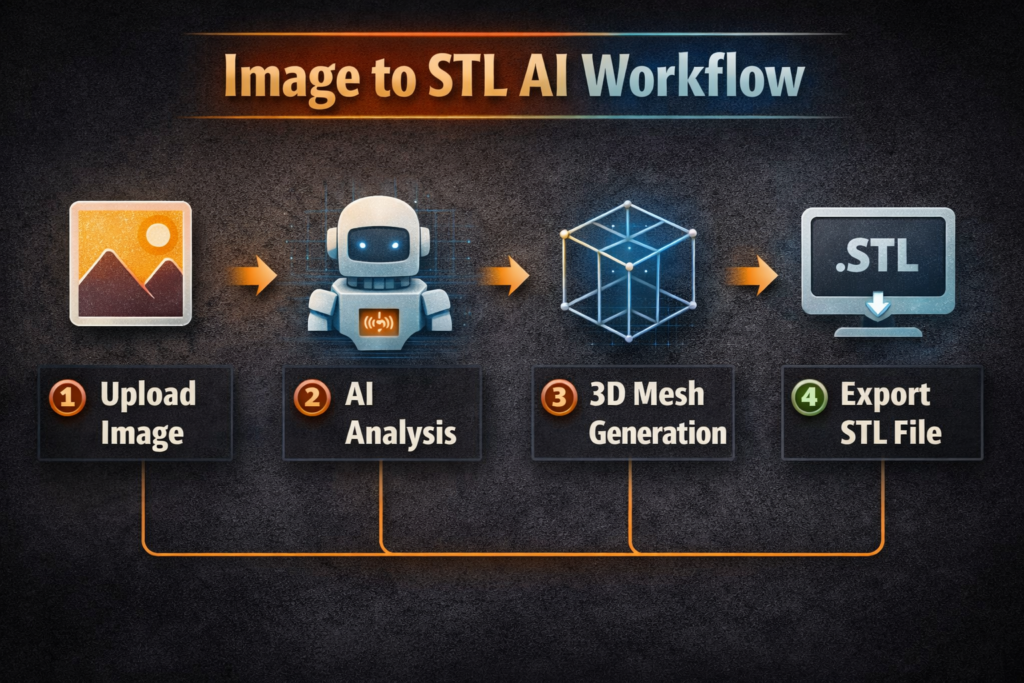
This workflow shows how Sloyd.ai Image to STL AI tools convert a simple image or prompt into a 3D printable STL model.
The concept behind Image to STL AI sounds simple but relies on complex machine learning technology.
These systems use generative modeling, where AI is trained on massive datasets of existing 3D models. By analyzing millions of shapes, the AI learns to understand:
- Geometry
- Depth
- Structure
- Surface details
Tools like Sloyd.ai use a method called parametric modeling. Instead of manually sculpting a model, the system generates objects using mathematical parameters.
When a user types a prompt or uploads an image, the AI calculates the most likely 3D structure and generates a mesh that can be exported as STL or OBJ.
This allows users to create 3D models in seconds instead of hours.
The Benefits of Using Sloyd.ai for 3D Modeling
AI modeling tools bring several exciting advantages, especially for beginners entering the world of 3D printing.
Speed of Creation
Traditional modeling can take hours or even days. AI can generate a base mesh in just a few seconds.
No Steep Learning Curve
You don’t need to understand complex 3D concepts like vertices, topology, or boolean operations. You simply describe what you want and the AI builds it.
Rapid Prototyping
If you need simple objects like furniture, props, or architectural shapes, AI tools can produce them extremely quickly.
Creative Inspiration
AI can also act as a brainstorming tool, generating rough concepts that designers can later refine into finished products.
For experimentation and learning, AI tools are incredibly powerful.
The Reality: AI vs Professional STL Files
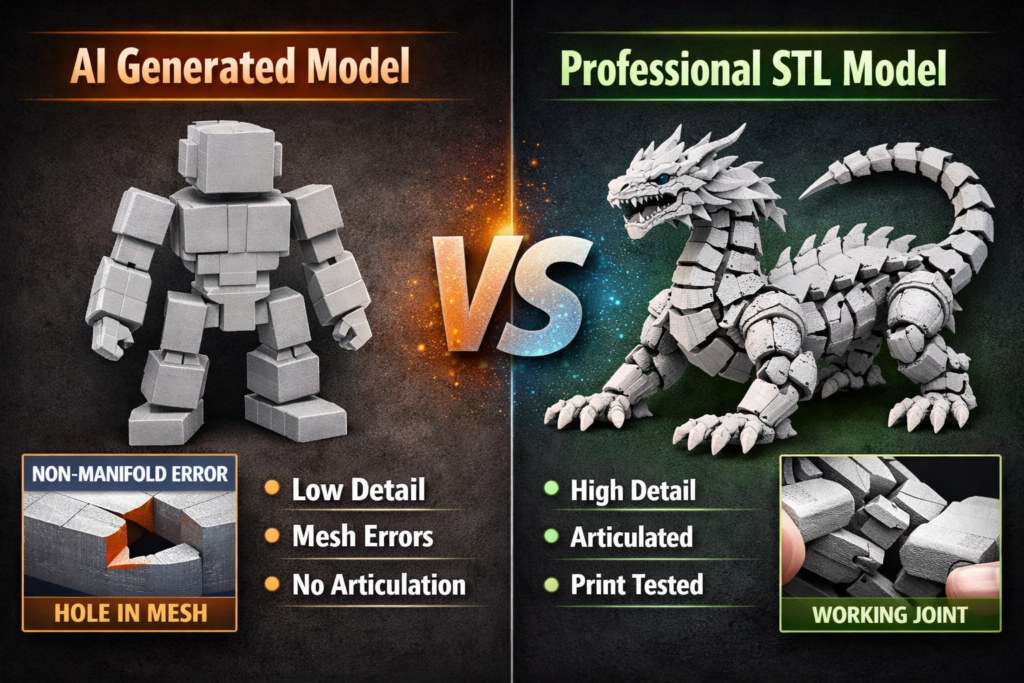
While AI-generated models are impressive, there is still a significant difference between an AI mesh and a professionally engineered STL file.
For anyone running a 3D printing business, this difference can mean the gap between a successful product and a failed print.
1. The Articulation Challenge
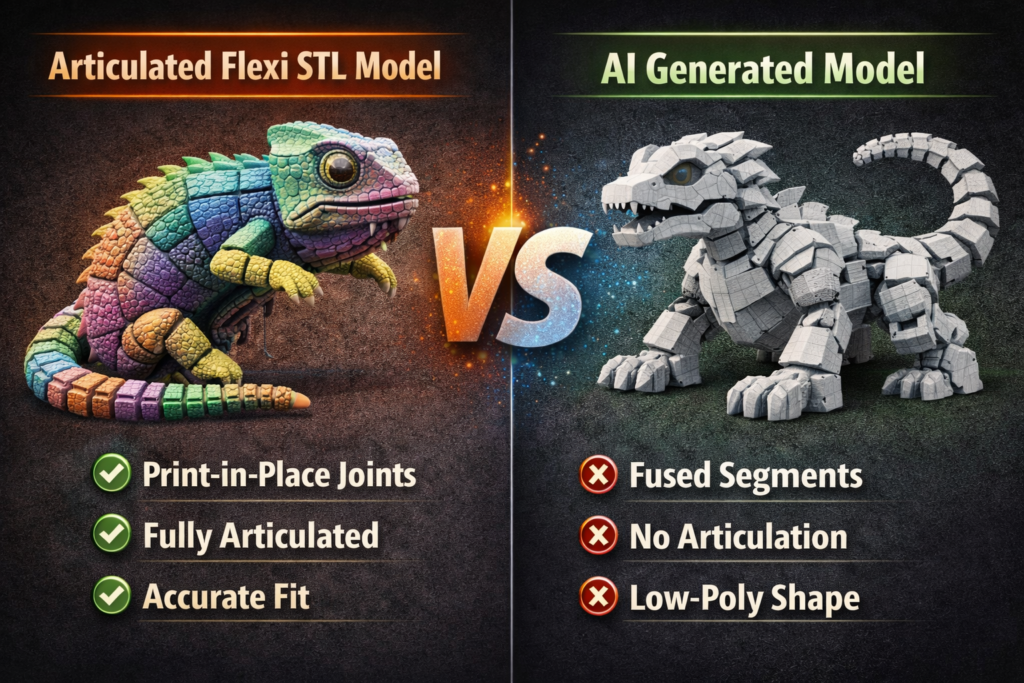
This example shows why Image to STL AI tools like Sloyd.ai still struggle to generate articulated flexi models for 3D printing.
This is one of the biggest limitations of Sloyd.ai Image to STL AI technology today, especially when it comes to articulated or print-in-place designs.
These designs use complex print-in-place joints that allow parts to move without assembly.
For example, in large collections like a Flexi Animal STL bundle, each model contains dozens of carefully engineered joints.
Currently, Image to STL AI tools struggle with this. Instead of creating working joints, the AI often fuses moving parts together, resulting in a solid object that cannot move.
Mesh Integrity and Manifold Errors
A 3D model must be watertight to print properly.
AI-generated meshes often contain:
- Non-manifold geometry
- Holes in the mesh
- Overlapping surfaces
- Broken topology
These errors confuse slicer software like Ultimaker Cura and frequently lead to failed prints.
Professionally designed STL files, such as those available on Get3DSTL, are manually checked and optimized to ensure they are fully manifold and ready to print.
Detail and Artistic Quality
AI performs well when generating generic shapes, but it still lacks the artistic touch of experienced designers.
Whether it’s:
- The intricate armor on an anime character
- The organic shape of an articulated dragon
- The realistic texture of a knitted-style model
Human sculptors add a level of detail and personality that AI cannot yet replicate.
This artistic quality is often what makes a 3D print stand out to customers.
Why Professional STL Models Still Dominate the Market
For hobbyists experimenting with ideas, AI modeling tools can be a fun playground.
However, if your goal is selling physical 3D prints, quality and reliability become critical.
Customers on marketplaces like Etsy expect:
- Smooth surfaces
- Perfect articulation
- Clean geometry
- Reliable prints every time
This is why curated marketplaces remain essential in the 3D printing ecosystem.
Platforms like Get3DSTL specialize in providing high-demand models that are professionally designed and optimized for real printers.
These files are tested for both FDM and resin printing, ensuring consistent results.
The Smart Approach: AI for Ideas, Professional Files for Production
The most successful makers today are adopting a hybrid workflow.
They use AI tools to:
- Brainstorm concepts
- Generate quick prototypes
- Explore new design ideas
But when it comes to their best-selling products, they rely on professionally designed STL files.
Instead of spending hours fixing broken AI meshes, many makers prefer accessing a curated library of ready-to-print models that are guaranteed to work.
This approach saves time, filament, and frustration.
Conclusion: Is AI Ready for Professional 3D Printing?
Sloyd.ai Image to STL AI tools represent an exciting step forward for automated 3D modeling.
They are fast, intuitive, and extremely useful for generating basic shapes and experimenting with new ideas.
However, for serious makers and 3D printing businesses, AI is not yet a replacement for professional STL marketplaces.
If you want reliable models that print perfectly and attract customers, professionally designed files remain the gold standard.
Instead of wasting filament on experimental AI meshes, many makers choose to build their businesses using tested, high-quality STL models from trusted libraries like Get3DSTL.